


Linearity and eroticism
Jan Dobkowski, without hesitation, can be counted among the leading avant-garde artists of Polish painting. His work breaks traditional conventions and sets new directions in art, causing almost a revolution in the perception of the painting medium. On the occasion of the artist's 81st birthday, we will take a closer look at his most famous red and green series of works, created in the late 1960s.
The uniqueness of his works is represented by bold colors, expressive gestures and deconstruction of traditional forms . Dobkowski explores various motifs, often reaching for abstraction and surrealism. A strong combination of red and green is its hallmark. Paintings painted using these colors caused a lot of interest in the media and among critics. They were presented for the first time as part of the exhibition "Secesja-Secesja?" at the Contemporary Gallery in Warsaw in 1968. Immediately after that, another success was brought by the exhibition in Paris "Polish Contemporary Painting 1917-1969 - Sources and Searches".
Amazing line flexibility
His first red and green painting, Double Girl, in 1968, was purchased by the Guggenheim Museum in New York , which was a huge honor. A year later, a whole series of them was created, which to this day is one of the most sublime, erotic representations of Polish contemporary art . The topic taken up at that time, thanks to its timelessness, constantly delights lovers of unconventional painting solutions.
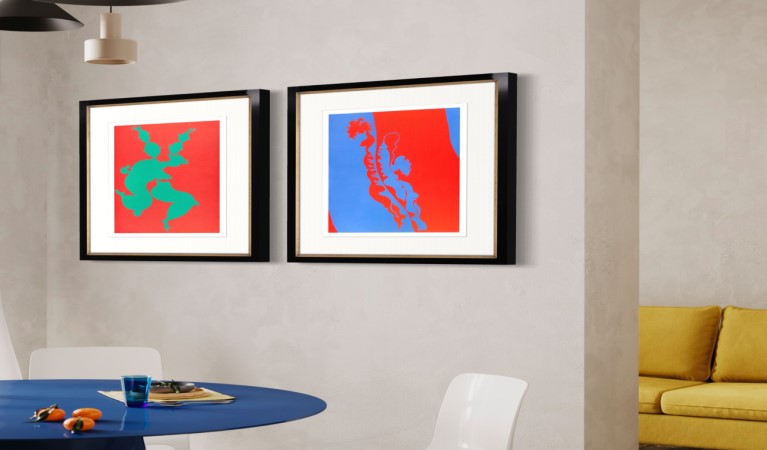
Perspective disappears on Dobkowski's canvases. The silhouettes appear as if levitating in space, they are not supported by anything. In addition, due to their unreality, scale does not seem to matter here. The works from this series differ from each other mainly in terms of dynamics and composition. The "unnecessary bow" is clearly dense, filled with red to the brim . "Spring joys" give you more breath , after squinting, they are just a patch of color placed in the center.
Conscious treatments
These are feminine and masculine shapes, firm bodies. However, they are presented so poetically that they have nothing to do with vulgarity. Contours of color patches shown in a euphemistic way, which speak of liberation, acceptance, coexistence of two. Bold, contrasting colors additionally enhance the expressiveness of lithe silhouettes. Thanks to this procedure , Dobkowski uses the effect of optical color vibrations. It shows a dynamic world, undergoing constant change, which is indicated by the trembling of the lines. His work is also characterized by pop-art new realism, as evidenced by the power of expression, simplicity and brevity.
Fascinated by the line, he fearlessly experiments with form, style and techniques , boldly pushing the boundaries of traditional artistic expression. Despite the passage of time, he created unique works, full of innovation and deep reflection on the body.


